If you can name the beaches, you’re ready for the rest of the war.
Most American WWII shelves stop at Overlord, the Bulge, and a flag on Suribachi. This one doesn’t. Fifteen campaign histories and memoirs — Russia, Spain, Berlin, Nuremberg, the Caucasus — in English, as ebooks. $105.99. About seven dollars a book. On your iPad tonight.
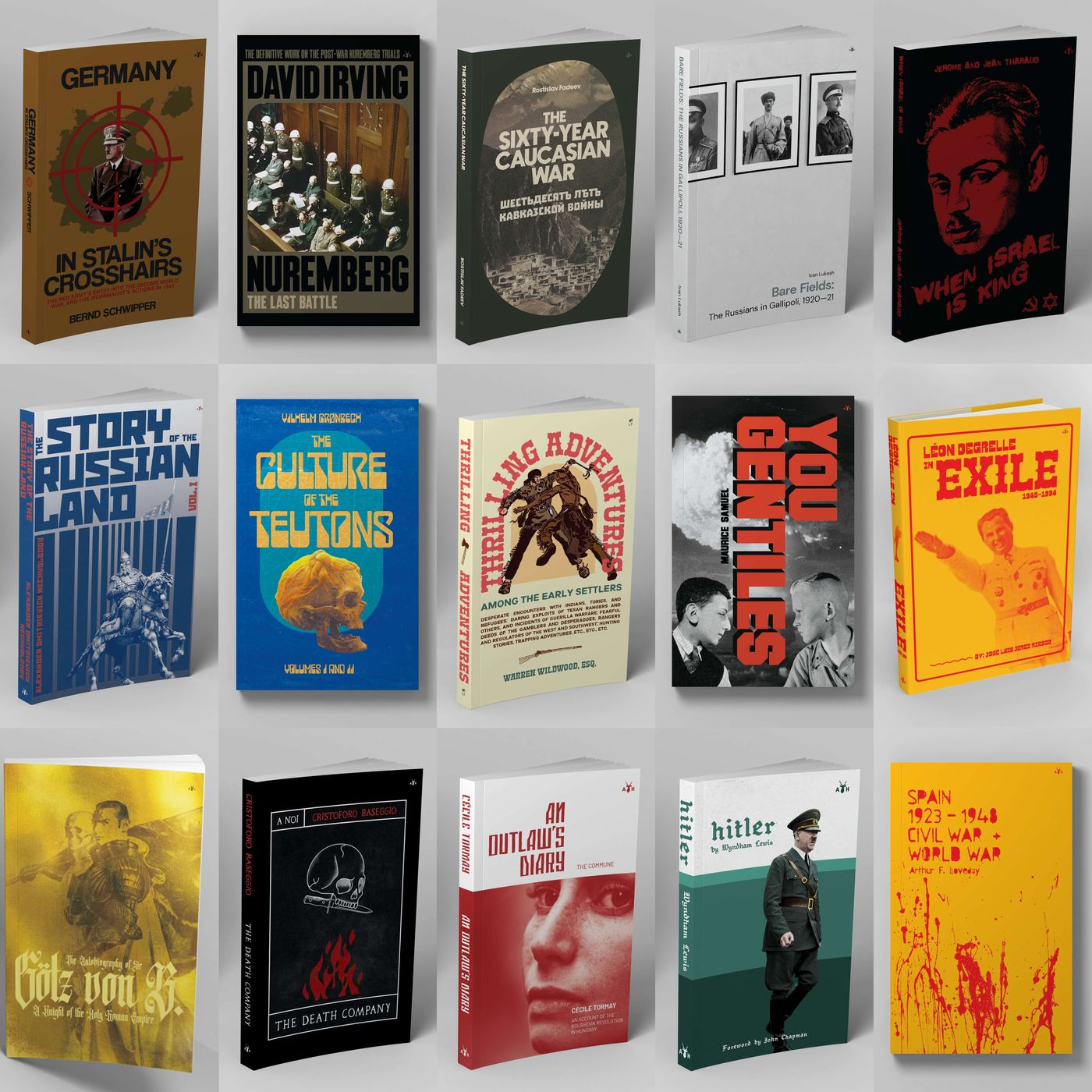
Campaigns & Memoirs · 15 ebooks · $105.99
No membership. No monthly club. No disc to scratch. Pay on this page. We email the files to the address you give at checkout.
You were taught one war. It was not the whole war.
Utah. Omaha. Gold. Juno. Sword. You can do that in your sleep. You know which division took Bastogne’s perimeter and who said “Nuts.” You can tell a Higgins boat from an LCVP without the caption.
That is not a beginner. That is somebody the History Channel has already used up.
Walk into a bookstore this week and watch what “World War II” still means: Band of Brothers, a Churchill brick, maybe a new Midway book, a D-Day photo slab for the coffee table. The Eastern Front is a chapter. Spain is a sidebar. The Caucasus does not exist. Nuremberg is a verdict, not a trial you can sit through on the page.
You already own that shelf. This is the next one.
What you actually get
Fifteen complete ebooks. Not excerpts. Not a “companion guide.” Not a streaming series that dumps you at a commercial.
The spine of the library is campaign history you cannot get from Sunday-night television:
- Germany in Stalin’s Crosshairs — the Eastern problem as German command framed it, before the map turned red.
- Spain 1923–1948 — dictatorship, civil war, world war. The peninsula as rehearsal hall.
- Bare Fields — White Russian remnants at Gallipoli, 1920–21. The wrong army, the wrong beach, after the wrong war.
- The Sixty-Year Caucasian War — Fadeev. If you follow that corner of the map in the news, this is the book that makes the names stop floating.
- Story of the Russian Land — the country that would break the Wehrmacht, told as a narrative history, not a lecture.
- An Outlaw’s Diary — Cécile Tormay, Budapest 1919. A woman who did not look away.
Then the books serious readers argue about, listed because they are in the box: Irving’s Nuremberg: The Last Battle. Wyndham Lewis’s 1931 Hitler, written before the war he could not yet see. Degrelle’s long exile. Read them as documents. Argue with them. That is the job.
And the winter-night titles: Götz von Berlichingen’s iron hand. An Italian assault unit in the first person. A 19th-century American frontier yarn that reminds you this country did not invent war in 1941. Grönbech’s Culture of the Teutons for the reader who is tired of being told “the Germans just appeared in 1933.”
EPUB. iPad, Kindle, laptop. Same day in most cases.
The math is not cute. It is just cheap for what it is.
A single campaign hardcover at a museum shop runs $32 to $45, plus shipping, plus six days of media mail.
Fifteen ebooks here: $105.99.
That is $7.07 a volume.
No club. No “three easy payments.” No binder that arrives minus volume 4. You pay once on this page. The files go to your email.
How it lands on the device you already use
These are EPUBs. Apple Books opens them on an iPad with one tap. Kindle takes them through Send-to-Kindle. Type size is yours. Eyes are not what they were in 1972. That is the point of an ebook, not a gimmick.
Use the email you actually check. That is how the product arrives. If a file is corrupt, we send it again. If we cannot fulfill, we refund. Digital sales are otherwise final once the files go out — same rule as every other ebook you’ve bought.
This is for you if:
- You pause a documentary to find the river and the corps boundary.
- You kept Keegan, Ambrose, the Time-Life set, or a footlocker of after-action reports.
- You are tired of D-Day being 80% of the American WWII conversation.
- You want the Eastern Front, Spain, and the Caucasus in English, on a screen you can enlarge.
- You do not need a host to tell you what to think. You want the pages.
If you want a children’s introduction to 1944, stop here. This is not that.
What’s on the shelf
Fifteen volumes. Each one is here for a reason. Read the list before you pay.
-
The North · deep background
The Culture of the Teutons
Vilhelm Grönbech, vols. I–II. A Danish scholar’s long look at the old North — kinship, law, and the culture later centuries never stopped arguing about. If you are tired of being told 1933 came from nowhere, start further back.
-
Eastern Front · the country that stopped them
Story of the Russian Land, vol. 1
Narrative history of the land the Wehrmacht walked into. Not a textbook. The story of the country that would break the German army, told as a country, not a chapter.
-
The Caucasus · the war under the mountains
The Sixty-Year Caucasian War
Rostislav Fadeev. The long imperial fight in the mountains that still puts names on the news. If you have ever paused a documentary because the map jumped to Chechnya or the passes, this is the book that makes those names sit still.
-
Aftermath of 1918 · the other Gallipoli
Bare Fields
The Russians in Gallipoli, 1920–21. White army remnants on the wrong beach, after the civil war, after the world war. The peninsula you know from 1915, used again by men who had already lost once.
-
Spain · rehearsal for the world war
Spain 1923–1948
Arthur F. Loveday. Dictatorship, civil war, then the wider war. If you have ever traced the Condor Legion, Guernica, or the internment of the defeated, this is Spain as a twenty-five-year campaign, not a sidebar.
-
Budapest 1919 · a woman who stayed
An Outlaw’s Diary: The Commune
Cécile Tormay. First person from a capital that went through revolution between the two wars. Written while it was happening. Not a later memoir with the answers filled in.
-
Old Europe · a fighting life
The Autobiography of Götz von Berlichingen
The iron hand. A knight who lost a hand and made a better one. If you like a war story that does not start in 1939, this is the one you read in a chair on a winter night.
-
Italian Front · assault troops
The Death Company
Cristoforo Baseggio. An Italian assault unit in the first person. Close fighting, not a staff-college map problem. For readers who already know the Isonzo was not a footnote.
-
American frontier · the other training ground
Thrilling Adventures Among the Early Settlers
Warren Wildwood. 19th-century American narrative. A reminder that this country did not invent hard campaigning in 1941. The palate cleanser on a shelf of European war.
-
Eastern Front · how the other staff wrote it
Germany in Stalin’s Crosshairs
Bernd Schwipper. The Soviet problem as German command put it on paper. If you have read Zhukov and Guderian and still want the staff view of the map turning, this is that file.
-
1945–46 · the trials
Nuremberg: The Last Battle
David Irving’s account of the postwar tribunals. Controversial. Not the last word, and not sold as one. It is in the box because readers who study the trials want to see what he wrote and set it next to the record they already trust.
-
1931 · before anyone knew the ending
Hitler — Wyndham Lewis, 1931
A modernist painter-writer looking at Germany in 1931, eight years before the war, fourteen years before the bunker. Period piece. Read it as a document from before the ending was known — not as a biography written after 1945.
-
1945–1994 · the aftermath
Léon Degrelle in Exile, 1945–1994
What happened after the shooting stopped to one of the war’s most notorious European volunteers. Forty-nine years of exile. Not a combat diary. The long after.
-
Hungary 1921 · a period report
When Israel Is King
Jérôme and Jean Tharaud. Two French journalists in revolutionary Hungary, 1921, after the Béla Kun months. A period report from a country that went red and then went the other way. Read it as 1921, not as a speech from now.
-
1924 · across the Atlantic
You Gentiles
Maurice Samuel, 1924. An American Jewish writer addressing the Gentile world in the years after the Great War. In the collection because the interwar argument was not only European, and not only one voice.
Historical sources and period literature. A listing is not an endorsement of the author’s views.
Send the 15-volume library
Campaigns & Memoirs · $105.99 · EPUB to the email you enter at checkout.
Uncheck the extras if you only want Campaigns & Memoirs. Checkout is on the next screen. No account to create.
Questions worth answering once
Will this work on my iPad?
Yes. Apple Books opens EPUB. Kindle uses Send-to-Kindle. Nothing to install from us.
Is this print?
No. Ebooks only. That is how the price stays near seven dollars a volume and the files arrive the same day.
Can I buy just the campaign library?
Yes. Leave the boxes unchecked. $105.99. The other two collections are optional.
What’s in the other two collections?
Europe Between the Wars is interwar political writing — the decade that made 1939. The German Papers is newly translated German primary sources, 1919–1945, listed title by title before you buy. Both are $105.99 if you want them.
Refunds
If we cannot send the files, we refund. Corrupt file: we resend. Once a good file has gone out, the sale is final. Full terms on the refunds page.